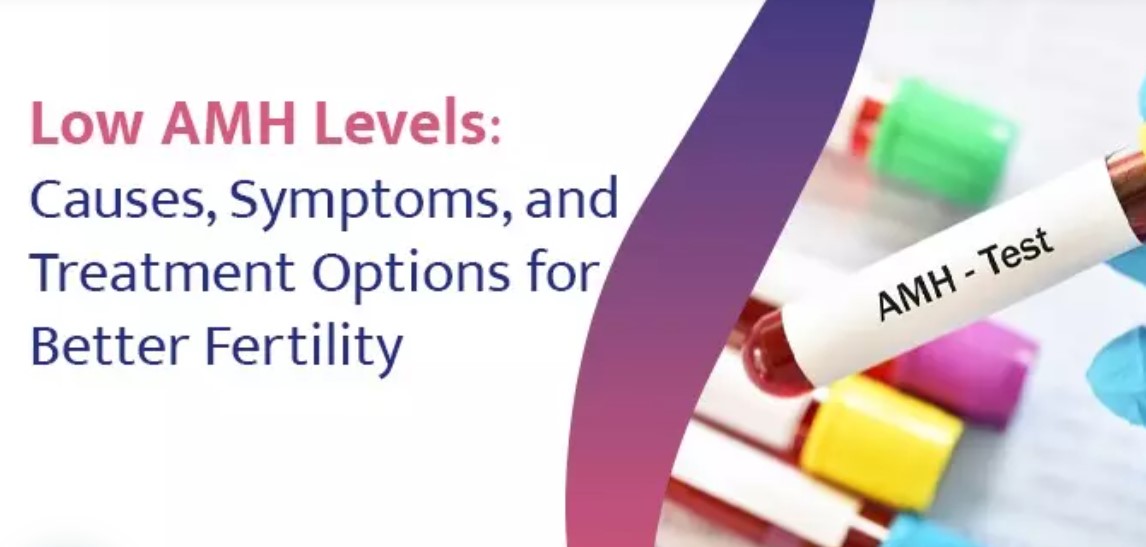
AMH, short for Anti-Mullerian Hormone, is a hormone produced by the developing follicles in your ovaries. It’s used as a marker for your ovarian reserve, i.e., the number of eggs available in your ovaries.
Knowing the importance of the AMH test, what are normal AMH levels by age, and the best low AMH fertility treatments are important, especially if you are planning to get pregnant. Read on for more about low AMH symptoms and treatment in Pakistan.
What Is AMH (Anti-Müllerian Hormone)?
Anti-Mullerian Hormone, as mentioned above, is produced by the small follicles in your ovaries. These follicles have immature eggs, one of which is usually released every month. AMH levels remain stable throughout your menstrual cycle, which is why the test can be taken at any time of the month.
Know that the AMH test is only a biological marker that gives a healthcare provider a clear picture of the remaining number of eggs in your ovaries. A low AMH can make conception difficult, but it doesn’t mean you can’t get pregnant.
This is used when the fertility specialist wants to know how you will respond to fertility drugs. The test is also done to help people know their fertility timeline and if they should consider cryopreservation.
Common Symptoms of Low AMH
There are no obvious symptoms that would indicate a low AMH count. In fact, the ovulation and menstrual cycles of women with a low AMH can be regular. The AMH test is the only way to know if you have low AMH. That said, these are the symptoms that might appear in some women.
- Irregular menstrual cycles
- Difficulty getting pregnant
- Not responding well to fertility medications
- Entering menopause sooner than expected
These may not be present in all women with low ovarian reserve.
Causes of Low AMH Levels
Low AMH can be due to genetic, lifestyle, or biological factors. Here are some common causes linked to low ovarian reserve.
- Age: The most common cause of a declining AMH is age. As your age advances, your egg count and quality diminish. It’s normal for women above 35 to have lower AMH compared to their younger counterparts.
- Genetic Factors: Genes also play a role in your ovarian reserve. Some girls might be born with a low ovarian reserve, thus showing a low AMH. These women are also at an increased risk of early menopause.
- Lifestyle Factors: Some lifestyle factors, such as poor diet, excessive alcohol consumption, smoking, chronic stress, poor sleep, obesity, and exposure to toxins, can deplete your egg count and affect their quality.
- Medical Conditions: Thyroid, lupus, and other autoimmune diseases can target your ovarian tissues, damaging the follicles. Premature Ovarian Insufficiency, in which the ovarian function declines at an early age, can also affect ovarian reserve. Besides, chemotherapy, radiation, or ovarian surgery for cysts or endometriosis can damage healthy ovarian tissues.
How Is Low AMH Diagnosed?
An AMH test in Pakistan is the most reliable way to diagnose AMH hormone in your blood. The test may or may not be done in conjunction with a transvaginal ultrasound, which gives a clear picture of the Antral Follicle Count (AFC). The results of AMH are interpreted based on your age. Here are the age-wise details of the normal AMH levels.
Note: Standard AMH levels vary by age and lab. It’s best to show your AMH reports to a fertility specialist to know if your AMH count is low or acceptable.
| Age | Average AMH (ng/mL) | Typical Normal Range (ng/mL) | Status |
| Under 20 | 4.0 – 6.8 | 3.0 – 8.5 | Very high |
| 20-24 | 4.0 – 5.5 | 2.5 – 7.5 | Excellent |
| 25-29 | 3.0 – 4.5 | 1.8 – 6.8 | Very good |
| 30-34 | 2.0 – 3.5 | 1.5 – 4.5 | Normal |
| 35-39 | 1.0 – 2.5 | 0.8 – 3.5 | Reduced, but conception is possible |
| 40-44 | 0.5 – 1.5 | 0.2 – 2.0 | Low ovarian reserve |
| 45-50 | 0.1 – 0.5 | <1.0 | Very low |
| Menopause | <0.1 | Nearly undetectable | Declined |
AMH levels between 0.5 and 1.0 are considered low. Women with these results might be advised to use Assisted Reproductive Technology (ART), such as IVF.
Low AMH Treatment Options in Pakistan
As you get older, your AMH level reduces. Age-related decrease in the ovarian reserve might also mean declining egg quality. Both of these factors can affect your fertility. Many women go on to conceive despite low AMH. A healthy pregnancy depends on many factors, including egg count, quality, sperm quality, and uterine health.
Can You Get Pregnant With Low AMH?
Yes, you can get pregnant with low AMH. Fertility specialists work with you to create an individualized treatment plan that can help you conceive. Remember, low AMH means fewer eggs, not zero. That said, no fertility specialist can guarantee a successful pregnancy. It’s best to stick to the professionals who offer evidence-based hope rather than false claims. Here is what helps.
- Lifestyle: Simple lifestyle modifications can help improve your reproductive health, but can’t directly increase your AMH levels. A healthy diet, quitting smoking and alcohol, weight management, adequate sleep, proper hydration, and stress control—all can help. In some cases, supplements are advised.
- Healthy Diet: Diet can also support ovarian health, improve egg quality, and slow egg loss. Focus on foods rich in antioxidants, as they protect your eggs from free radical damage. Other essential nutrients that can support your egg quality include CoQ10, B Vitamins, Iron, and Zinc.
- Weight Management: Being underweight or overweight can disrupt your hormonal balance, which can negatively affect your fertility. A healthy Body Mass Index (BMI) can improve your ovulation cycles, i.e., the egg maturity, which increases the chances of fertilization.
- Stress Reduction: Constant stress can increase cortisol levels, which can affect your reproductive hormones. Hormonal imbalance can disrupt ovulation. Besides, stress can also increase oxidative stress, which can damage egg cells. Stress-reduction practices, such as meditation, journaling, sleep, yoga, and exercise, can improve fertility outcomes.
Fertility Medications
If you have low AMH, fertility medication, which gently stimulates your ovaries to release a mature egg, is used. The goal is to create a customized treatment plan depending on your ovarian reserve, health status, fertility goals, age, and weight. Remember, no medicine or dosage can increase the egg count.
A fertility specialist will prescribe medication that can help them get a couple of healthy eggs, which can result in a successful pregnancy. Your follicles are monitored regularly until the medication stops. The doctor prescribes bloodwork and ultrasound scans to track follicular growth. Regular monitoring is essential to prevent understimulation or overstimulation.
IVF Treatment for Low AMH
IVF for low AMH might be helpful in cases where natural conception isn’t happening. Since the egg count is already low, fertility specialists employ techniques to use the available eggs efficiently.
- Advanced Lab Support
Normally, eggs released during ovulation may not get fertilized. In women with low AMH, every egg counts. Besides, IVF provides a suitable environment for eggs to fertilize and turn into a healthy embryo that can implant successfully. It’s done in a controlled environment, with devices that support 24/7 embryo monitoring.
- Use of ICSI
In case of male-factor infertility, Intracytoplasmic Sperm Injection (ICSI) — a procedure that injects a single sperm cell into the egg directly can make a big difference in the IVF success. It’s also helpful in low-AMH-related infertility cases. The procedure maximizes the chances of fertilization and, thus, implantation.
Egg Freezing & Fertility Preservation
If you are diagnosed with low AMH early or plan to preserve your fertility for the future, preserving your eggs through cryopreservation can be the most effective step. It freezes your eggs, which are then thawed and used later when you plan pregnancy. The procedure is similar to IVF, except for the timeline.
Instead of being transferred immediately after embryo culture, the eggs or embryos are stored and transferred when you are ready to conceive. Egg freezing is particularly beneficial for women who are diagnosed with low AMH and are not planning pregnancy soon, as their ovarian reserve will continue to decline, making conception more difficult later.
IVF Success With Low AMH – What Affects Outcomes?
There’s no clear-cut answer to the question “Can you get pregnant with low AMH?” However, IVF has been proven as an effective treatment option. That said, it doesn’t always work. The success rate depends largely on:
- Female age: Younger women (those below 35) have a higher chance of conceiving through IVF.
- Egg quality: Good egg quality can result in a successful implantation.
- Treatment protocol: A personalized treatment can help you achieve your fertility goals.
- Lab expertise: A lab with proper ventilation, temperature regulation, and a controlled environment that mimics a woman’s womb can lead to healthy embryo development.
When Should You See a Fertility Specialist?
It’s important to seek medical attention if you fall into any of these categories:
- You have been trying to conceive for more than 6-12 months, but haven’t seen results.
- You want to preserve your fertility
- Your blood test shows a low AMH
- You have a history of failed IVF, IUI, and other ART procedures
Why Choose Australian Concept for Low AMH Treatment in Pakistan?
At ACIMC, we believe that every patient’s fertility journey is unique. Everyone has different struggles. We understand that infertility is not just physically challenging, but also mentally overwhelming. We provide you with compassionate care and a welcoming environment. Our fertility centers are spread across 15 branches in Pakistan, covering Karachi, Lahore, Islamabad, Rahim Yar Khan, and other cities.
Our trusted fertility specialists are trusted by couples across Pakistan, making our clinic one of the most reputable and leading IVF centers in the country. What sets us apart is our personalized treatment approach. At ACIMC, people feel confident as they are heard.
We are equipped with a state-of-the-art embryology lab, featuring time-lapse embryo monitoring and cryopreservation facilities. We also have a diagnostic unit within the clinic, providing you with all medical services under one roof.
FAQ
- Can AMH levels be increased naturally?
No, AMH can’t increase, but the egg quality can be improved, or the egg loss can be slowed.
- Does low AMH mean menopause?
No, it’s not necessary. Many women with low AMH continue to have periods and ovulation for many years.
- Is IVF the only option for low AMH?
It’s for the severe cases. Many women conceive naturally or with conservative treatments.
- Can I get pregnant naturally with low AMH?
Yes, it’s possible to get pregnant naturally even with a low AMH.
- Is the AMH test accurate?
Yes, the test results are often reliable. However, for better accuracy, they are often combined with AFC and other tests.
- Does age matter more than AMH?
Yes, advanced age can lead to a rapid decline in egg quality.
- How fast should I act after a low AMH result?
The sooner the better. It’s best to visit a fertility specialist immediately if you have fertility goals.
- Can supplements improve AMH?
Supplements can improve your ovarian function, but these must only be taken under medical supervision.





2 Comments
Muhammed Ahmed
Assalam o Allikum
MA SHA ALLAH we have 4 kids, 3 Daughter and 1 Son.
Physically both are fit.
we wish a baby boy for completing our family.
I am not a rich man. I am simple account assistant in a real estate farm and dose not afforded so much fees recently i have receive a comety PKRs 80,000/-
If these rupees the process are possible then Please contact me
We both are at the age of 40
Regards
Muhammed Ahmed
ACIMC Webmaster
Dear,
We have experienced Consultants at ACIMC. Please come for a first free consultation with coordinator doctors.
For an appointment please call on our UAN: 0304-111-2229, WhatsApp: 0309-333-2229