If you have recently gone through IVF, the one number you may be keeping an eye on is Human Chorionic Gonadotropin (hCG). It’s a pregnancy hormone, which normally rises when pregnancy is established. So, rising hCG is often a good sign.
But how much should it rise, and what if it rises unusually fast? Does it mean you are pregnant with twins? Or is that a normal part of a single pregnancy? In this post, you will learn the role of beta hCG in confirming pregnancy through twin hCG levels after IVF chart.
Human Chorionic Gonadotropin: hCG Levels in IVF Pregnancies
Beta hCG, or simply hCG, is a pregnancy hormone that’s released after implantation. When the fertilized eggs attach to the uterine lining and implant successfully, the pregnancy cells that form the placenta release human chorionic gonadotropin hormone.
It’s responsible for maintaining pregnancy in the initial weeks. The hormone levels are at their peak at the end of the first trimester, i.e., around 10-12 weeks, before they start declining throughout the rest of your pregnancy.
Now, hCG is released into the bloodstream, becoming detectable in a blood or urine test. That’s why it’s used as the most reliable pregnancy marker. Fertility experts do not usually rely on a specific hCG number in early pregnancy. They rather look at whether the hormone is doubling every 48-72 hours, or rising at an unexpected pace.
You can take a home pregnancy test, which detects hCG in urine, but a more reliable option is a blood test. It gives the exact concentration of the hormone in your bloodstream, thus allowing your doctor to repeat the test and compare hormone levels.
When Does hCG Start Rising After Embryo Transfer?
One factor that determines when hCG starts rising after implantation is the developmental stage of the embryo at the time of transfer. For example, if the embryo was transferred at a 5-day blastocyst stage, it has already sufficiently developed. Chances are, the pregnancy hormone will be produced shortly after implantation takes place, which is usually a few days after embryo transfer.
That said, beta hCG levels can vary significantly between two women, even if they had the transfer on the same day. Research shows that hCG might be detected in IVF pregnancies as early as 7-9 days, although women are advised to wait at least two weeks for a pregnancy test.
That’s because, compared to embryos that develop in normal pregnancies, the IVF embryo is already five days old. That said, embryos transferred on the third day of development may require additional time to develop before they implant.
To help you understand better, let’s see what may happen after the blastocyst transfer.
Days 1-2: The embryo might attempt to attach to the uterine lining.
Days 2-4: Implantation may become successful if you have a favorable uterine condition, a healthy embryo, or no underlying issue that could prevent the embryo from attaching to the uterus.
Days 4-6: Cells that form the placenta may start producing hCG.
Days 7–9: A blood test might detect hCG.
Days 9-14: Beta hCG levels start rising and may become easily detectable in your blood. That’s why most fertility specialists recommend a blood test around this time.
These are general guidelines, not a strict standard. Every pregnancy develops at a different pace, and how hCG rises can vary between women.
Twin hCG Levels After IVF Chart
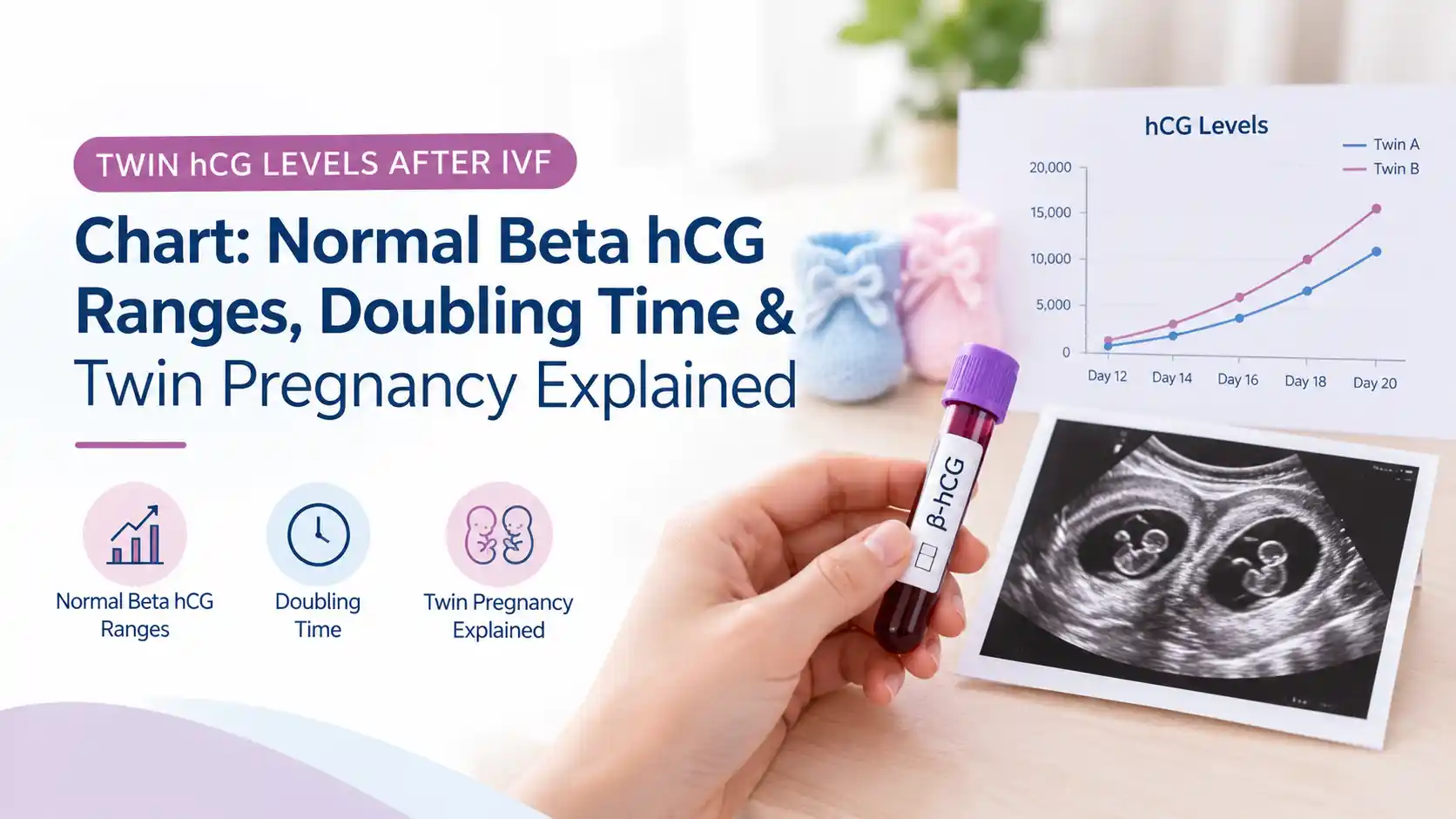
This twin hCG levels after IVF chart may give you an estimated range of rising hCG levels in singleton and twin pregnancies, but it’s not a definitive way to tell whether you are carrying a single baby or multiples. In fact, a blood test should never be used as a reliable way to detect twin pregnancies.
| Days after Embryo Transfer (Blastocyst Transfer) | Singleton Beta hCG | Twin Beta hCG |
| 7 days | ~5–50 mIU/mL | ~10–80+ mIU/mL |
| 8 days | ~10–75 mIU/mL | ~20–120+ mIU/mL |
| 9 days | ~20–150 mIU/mL | ~40–300+ mIU/mL |
| 10 days | ~30–250 mIU/mL | ~60–500+ mIU/mL |
| 11 days | ~50–400 mIU/mL | ~100–800+ mIU/mL |
| 12 days | ~75–600 mIU/mL | ~150–1,200+ mIU/mL |
| 13 days | ~100–800 mIU/mL | ~200–1,600+ mIU/mL |
| 14 days | ~150–1,000+ mIU/mL | ~300–2,000+ mIU/mL |
hCG Doubling Time After IVF
Once your pregnancy results are positive, your fertility expert will likely watch the hCG rising pattern rather than how high it is. In the initial days, the hormone rises rapidly, almost doubling within 48-72 hours. Slow-rising hCG might warrant close monitoring. It could be a sign of an early pregnancy loss or ectopic pregnancy.
Plateauing hCG is even more concerning. It’s when the hormone levels remain the same or change very little in early pregnancy. A declining hCG can be a sign of a pregnancy loss, although fertility experts usually conduct more tests to confirm.
This clearly shows how the pattern of rising hormones matters more than a number detected on one test. Repeated beta-hCG tests give your doctors important clues regarding how the pregnancy is progressing.
Do Twin Pregnancies Have Higher Beta hCG Than a Singleton Pregnancy?
In some cases, yes. The additional developing placental tissue can naturally produce more beta hCG, thus resulting in higher levels of the hormone in your blood. That, however, doesn’t automatically mean you have twins growing in the uterus.
Sometimes, hCG levels might be within the normal range of a singleton pregnancy even when you are carrying twins, while mothers pregnant with a single baby might produce extraordinarily high beta hCG.
The reason alone is enough to explain why ultrasounds are the only effective diagnostic tool to determine the number of gestational sacs or babies developing inside the uterus. It’s also important that you do not compare your hCG results with those of another woman going through IVF at the same time.
Not all high hCG levels mean a twin pregnancy. Sometimes, rare conditions in IVF, such as molar or ectopic pregnancies, can secrete excessive pregnancy hormone, which is why higher than normal hCG levels should always be monitored closely.
Can Normal hCG Still Mean Twins?
Yes, it’s absolutely possible to be carrying twins but have hCG levels that seem to be low for a twin pregnancy. The difference happens because you can’t accurately predict the exact time of implantation. For example, your hCG levels could be lower than another woman’s, simply because the implantation occurred later in your cycle.
Factors That Affect hCG Levels
Many factors can influence your hCG level, which is why knowing what’s happening inside matters.
Implantation Timing: This is the most common factor affecting hCG levels. If the embryo was transferred at an earlier stage of development, it may take comparatively longer to implant into the uterus compared to a 5-day blastocyst stage embryo transfer. This can create a noticeable difference between hCG levels.
Fresh vs Frozen Transfer: hCG levels during early implantation days can also vary between fresh and frozen embryo transfers, with FET pregnancies linked to slightly higher hCG levels on the same days after transfer as fresh embryo transfer. This could happen because the uterine environment may be more prepared in a future ovulatory cycle. However, that’s just one study, not a universal difference.
Number of Embryos: If multiple embryos were transferred, there’s a possibility of more than one embryo attaching to the uterine wall, which eventually may produce more hCG than a singleton pregnancy. However, multiple embryo transfers don’t necessarily mean that all embryos will attach. So, it depends largely on how many of them implant successfully.
Vanishing Twin Syndrome: Sometimes, the higher beta hCG levels could indicate vanishing Twin Syndrome, a condition in which one of the twins remains healthy while the other embryo stops developing and the tissue is reabsorbed by the mother’s body. The higher hCG, in such cases, is typically from an earlier-established twin pregnancy.
Testing Time: Test timing is the most crucial factor affecting the beta hCG levels. Even if the test is conducted a day or two later or earlier than in other pregnancies, the number might be significantly different, as beta hCG changes rapidly in the early weeks of pregnancy.
When Should Beta hCG Be Repeated?
Once you have had a positive pregnancy test, you will be required to have it checked again within 48 hours. The goal isn’t simply to check if the levels are high enough, but to assess how they are rising. For example, let’s say your beta hCG was 100 mIU/mL on the day the pregnancy was established.
This number alone doesn’t provide much information about whether your pregnancy is growing normally. If this number rises to 200-220 mIU/mL two days later, it’s considered a good sign. Likewise, if the level rises to 105 mIU/mL or stays the same, your fertility team may monitor your pregnancy more closely.
When Can Ultrasound Confirm Twins?
As mentioned above, ultrasounds give your healthcare team a clearer picture of how well your pregnancy is progressing and whether you are carrying a single or twins. A transvaginal ultrasound may be scheduled shortly after a positive beta hCG result. It helps identify gestational sacs, followed by subsequent ultrasounds that may detect yolk sacs, as well as the number of embryos that have implanted.
When exactly the first ultrasound is conducted can vary from clinic to clinic, but most order the test around 6-7 weeks of pregnancy. If you have a twin pregnancy, multiple gestational sacs can be found in this early scan. The ultrasound also shows whether the embryos (if there’s more than one) are developing in their separate sacs.
When Should You Contact Your Fertility Specialist?
Your fertility expert will explain to you the unusual symptoms that require an immediate visit to the fertility clinic. Here’s what you must watch out for:
- A declining, slow-rising, or plateauing beta hCG
- Significant bleeding with bright red blood or clots
- One-sided abdominal pain
- Persistent pelvic cramps
- Shoulder pain, dizziness, and fainting
Severe pelvic pain that radiates to the shoulders or occurs with heavy bleeding and dizziness can be a sign of a ruptured ectopic pregnancy, a medical emergency requiring immediate medical intervention.
FAQs
Is 500 beta hCG high after IVF?
A beta hCG of 500 can be a reassuring sign of a healthy pregnancy, but what matters more is when it was tested.
Can twins have low beta hCG?
Yes, many twins have beta hCG levels that match singleton pregnancies, but most may have higher hCG levels because more placental tissue is developing than in single pregnancies.
Can high hCG mean triplets?
It can be due to twin or triplet pregnancies, but beta hCG cannot confirm if you are carrying multiples. Ultrasound should be conducted.
Does FET change beta levels?
Yes. It may change the hCG levels because the uterine environment may be different than in those with fresh embryo transfers.
How many days after transfer is beta reliable?
Beta hCG is detectable early in IVF pregnancies, but most clinics stick to the 9-14 days protocol for pregnancy testing.
Does a high beta hCG mean a healthy pregnancy?
What matters more is a rising hCG. Your fertility expert will order an ultrasound to check gestational sacs, fetal cardiac activity, and their growth pattern to assess your pregnancy.
Can hCG decrease and still be normal?
A falling hCG should always be evaluated by a healthcare expert. In some cases, it could be due to vanishing twins, but instead of making assumptions, you must visit your fertility clinic.
Can home pregnancy tests predict twins?
No, it cannot predict the number of embryos growing in your uterus. It only shows a positive result when the hCG levels in your blood reach a specific threshold.
What is a normal beta after 5-day embryo transfer?
There’s no specific normal beta hCG after embryo transfer. It varies between pregnancies and depends on when the implantation occurred.
Can beta hCG predict baby gender?
No, beta hCG cannot tell the gender of your baby.
Conclusion
It’s natural to assume that higher than normal hCG can mean a twin pregnancy, especially if you have had multiple embryos transferred during an IVF cycle. However, it isn’t reliable proof of the number of embryos that have implanted into your uterus. Higher hCG levels can be due to other reasons, such as testing when significant placental tissue has developed. An ultrasound gives a clearer answer.







2 Comments
Muhammed Ahmed
Assalam o Allikum
MA SHA ALLAH we have 4 kids, 3 Daughter and 1 Son.
Physically both are fit.
we wish a baby boy for completing our family.
I am not a rich man. I am simple account assistant in a real estate farm and dose not afforded so much fees recently i have receive a comety PKRs 80,000/-
If these rupees the process are possible then Please contact me
We both are at the age of 40
Regards
Muhammed Ahmed
ACIMC Webmaster
Dear,
We have experienced Consultants at ACIMC. Please come for a first free consultation with coordinator doctors.
For an appointment please call on our UAN: 0304-111-2229, WhatsApp: 0309-333-2229