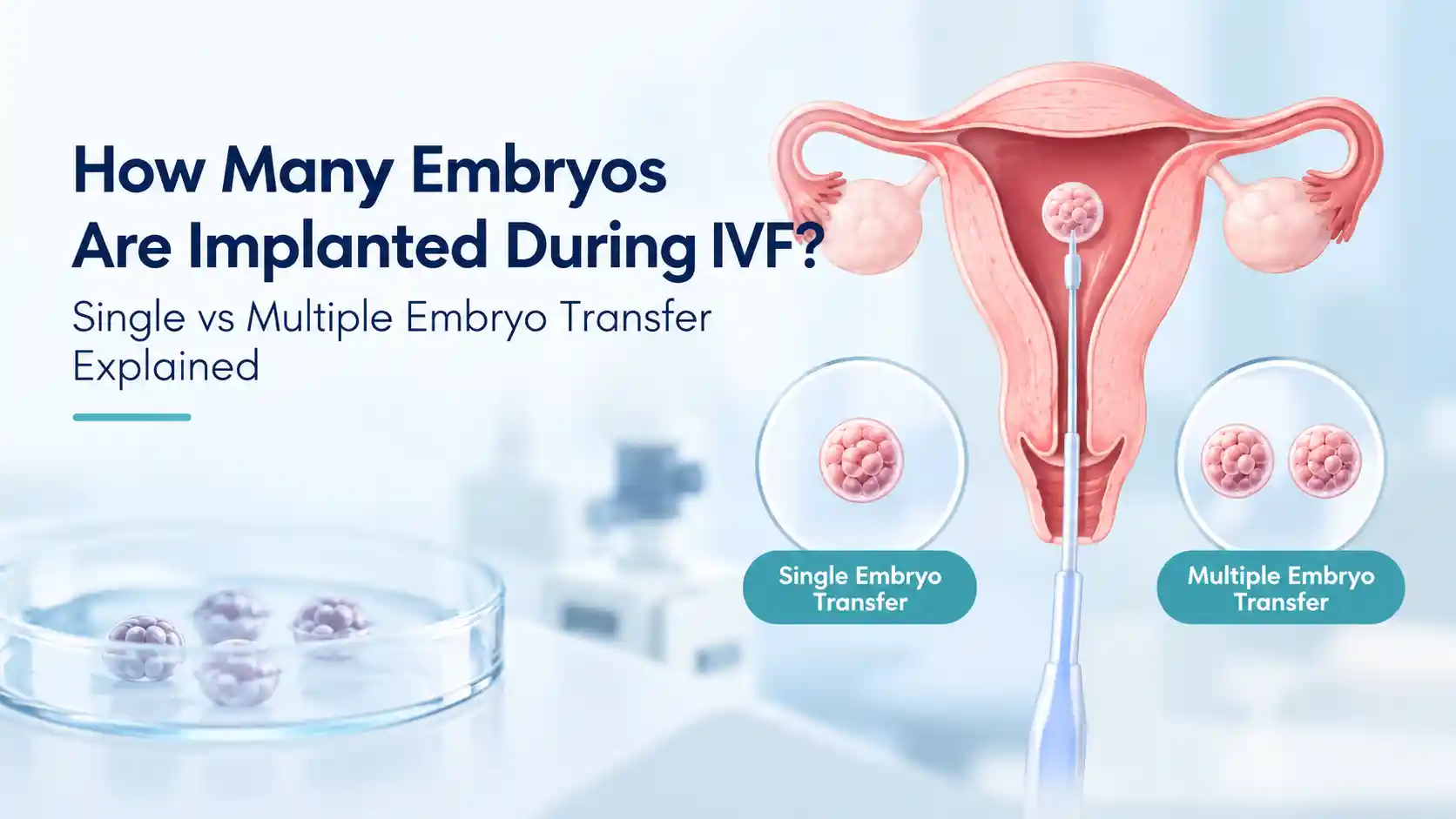
After stimulation, fertilization, and embryo culture, the next step in your IVF journey is embryo transfer. Couples often ask: How many embryos are implanted during IVF? Many people assume that the higher the number of embryos transferred into the uterus, the higher the chances of pregnancy.
However, it’s not that simple. IVF itself is a complex procedure, the success of which depends on many factors, such as your uterine environment, embryo quality, sperm quality, and so on. In this post, we’ll walk you through a detailed explanation of IVF embryo transfer guidelines. Let’s get started.
What Happens During Embryo Transfer?
Embryo transfer is the final stage of an IVF cycle, but many carefully planned steps happen before the embryo is ready to be transferred into the womb. Let’s understand the process in detail.
Egg Retrieval
Once your ovaries are stimulated to produce multiple follicles that can yield mature eggs, these eggs are collected through a small procedure called egg retrieval.
Fertilization
Once the follicular fluid is aspirated, it is sent to the lab where the eggs are retrieved and fertilized with sperm in a specialized container. It could be done through conventional IVF, where sperm and eggs are placed together to fertilize overnight, or via ICSI.
Embryo Culture
The resulting embryos are nurtured in an embryology lab, which offers a regulated and controlled environment, developing and preparing the embryo for transfer. Mostly, fertility experts culture the embryo for 5-6 days, i.e., until they reach the blastocyst stage.
Embryo Grading
Your embryologist checks the embryo’s morphology and quality, which allows them to select embryos that have a better chance of implantation. Some couples are advised to take PGT (a screening test that detects chromosomal abnormalities or genetic disorders in embryos). This step is done before transfer.
Embryo Transfer
Your fertility expert will schedule a short outpatient procedure for embryo transfer. A thin, flexible catheter is inserted into the vagina and is guided all the way through your vaginal canal to the uterus. Once it’s reached there, the embryos are released. Note that embryo transfer and implantation are not the same thing. Not every transferred embryo implants.
Fresh vs Frozen Embryo Transfer
The selected embryos can either be transferred on the same IVF cycle, called fresh transfer, or be frozen and used later in a future cycle. The latter is called frozen embryo transfer. With modern vitrification techniques, it’s possible to freeze embryos as long as you want. These embryos are thawed and transferred into your uterus when you are ready.
How Many Embryos Are Usually Transferred During IVF?
There are no universal criteria regarding how many embryos should be transferred in an IVF cycle. It depends largely on the patient’s individual anatomy and reproductive health. Earlier, most clinics would transfer multiple embryos, as it was believed to increase the success rate of pregnancy.
However, with vitrification technology, modern embryology labs, advanced embryo monitoring techniques, and embryo screening procedures, such as PGT, many clinics now follow a single embryo transfer protocol. It reduces the risk of multiple pregnancies while still maintaining your chances of conception through a single embryo transfer.
Research by the National Center for Biotechnology Information shows that to have a 90% implantation success rate, you need at least 3 euploid embryos. Furthermore, if these embryos are transferred in three separate IVF cycles, the combined chances of a successful implantation can be 95% if your uterus is in good condition and you don’t have any underlying medical issue that might interfere with pregnancy.
However, research suggests an increased success rate when embryos are transferred one at a time rather than all three of them being transferred at once.
Why Do Most Fertility Specialists Recommend One Embryo?
A fertility expert doesn’t just recommend a treatment that can boost your chances of conceiving, but they carefully plan a personalized approach that can give you the best chance at a healthy pregnancy while reducing avoidable risks. Here’s why a single embryo transfer can be a better choice.
It’s Enough
A single embryo, especially in women under 35 or with good egg reserve and quality, is sufficient. Besides, modern techniques allow embryologists to grade embryos, check their quality, and evaluate their characteristics thoroughly before choosing the one embryo that’s a perfect fit for transfer.
Reduced Twin Pregnancy Risk
With multiple embryos being transferred into the uterus, there’s a possibility that more than one embryo could attach to the uterine lining, resulting in a twin or triplet pregnancy. Such pregnancies are considered high-risk for IVF patients and might increase the risk of premature birth and other pregnancy-related complications.
Blastocyst Transfer
Advanced embryology settings and a controlled environment allow the embryo to continue growing to reach the blastocyst stage. This gives your fertility team a clear idea of which embryos are capable of growing and may have a higher chance of implantation after transfer. This makes a single-blastocyst transfer a better option, as it may offer implantation rates similar to the double-blastocyst embryo transfer, without the twin pregnancy risk.
When Are Two Embryos Considered?
A double embryo transfer, as the name suggests, refers to transferring two embryos into the uterus in the same IVF cycle. A single transfer is largely preferred these days, but depending on your individual case, age, and reproductive health, a fertility expert may discuss double embryo transfer. Here’s when it may be considered:
- Advanced maternal age
- A history of unsuccessful IVF and other ART treatments
- Low ovarian reserve and poor embryo quality
- A less-favorable prognosis
Double embryo transfer shouldn’t be perceived as twice the chance of successful implantation. On the other hand, it may also increase the chance of both embryos implanting, thus leading to twin pregnancy. The decision is, therefore, carefully made after weighing the benefits of multiple embryo transfer and the risks of multiple higher-order pregnancy.
Does Transferring More Embryos Increase Pregnancy Success?
When you have been struggling with infertility or failed IVF treatments for years, your instinct would be to have as many embryos transferred into the uterus as clinically possible to maximize your IVF success rate. However, the number of embryos does not have much to do with implantation success. The quantity doesn’t equal quality here.
Transferring more embryos may raise the likelihood of conception, but only in selected cases. For example, transferring a single euploid embryo at a blastocyst stage may offer the same chance of implantation as two high-quality embryos.
What Are the Risks of Multiple Pregnancy?
You may wonder why twin pregnancy is considered risky. Having two babies might sound great for couples who have faced tons of issues in getting pregnant naturally. And many twin pregnancies may go on smoothly. However, medically speaking, twin pregnancies carry more risk than a singleton pregnancy. Let’s review a few common issues:
Premature Delivery
A twin pregnancy puts immense stress on the cervix and maternal body, increasing the chances of premature birth, i.e., when the babies are born before 37 weeks of gestation. The risk is even higher in triplets or multiple higher-order pregnancies.
Premature birth can cause many complications, such as breathing issues and difficulty maintaining body temperature, or a prolonged stay in a neonatal care unit.
Low Birth Weight
Twin babies are also more susceptible to being born with low birth weight, primarily because they are born prematurely. Besides, they share limited uterus space, nutrition, and oxygen. There could also be uneven blood flow between the two fetuses. A low birth weight baby may require specialized medical care, feeding support, and a stay in the NICU.
Gestational Diabetes
The risk of gestational diabetes is higher in women carrying multiples compared to singleton pregnancies. That’s because pregnancy hormones and insulin resistance may rise rapidly in such pregnancies. Your fertility expert may monitor your blood glucose level throughout the pregnancy and may advise dietary and activity modifications to minimize your risk.
Preeclampsia
Preeclampsia is a high blood pressure complication in pregnancy, which may appear with signs of damage to the kidneys, liver, and other vital organs. The risk is particularly higher in women carrying twins, which is why twin or triplet pregnancies are closely monitored.
Cesarean Delivery
The increased risk of maternal and fetal complications in twin pregnancies makes cesarean birth more likely. While some women carrying twins may deliver vaginally, a cesarean may be needed if one baby is in a breech position. Sometimes, one baby is delivered vaginally, but the twin can face complications, such as distress, wrong position, or umbilical cord prolapse, requiring an emergency C-section.
How Do Fertility Specialists Decide How Many Embryos to Transfer?
As mentioned above, there’s no standard protocol for the number of embryos transferred in an IVF cycle. Your fertility expert may consider several factors to determine the most suitable option for your case.
Age: Advanced maternal age is associated with declining ovarian function, low ovarian reserve, and a higher proportion of embryos with chromosomal abnormalities. Advanced age can therefore affect the embryo’s quality and implantation success rate. Your fertility may consider double embryo transfer if you are 35+ or have had previous failed IVF cycles.
Embryo Grading: After culture, embryos’ quality is assessed. The doctor may essentially check the inner cell mass and trophectoderm. This helps them select the embryos suitable for transfer.
IVF History: Your fertility treatment history also matters. If you have had multiple failed IVF cycles, your fertility expert may look at the treatment history to identify the underlying issue. Depending on your case, they may transfer two embryos in your subsequent IVF cycle.
PGT-A: If you want to reduce the risk of twin pregnancy without compromising on the IVF success rate, PGT-A can be one way to achieve that. It helps select a single euploid embryo that may already have a good chance of implantation, thus eliminating the need for multiple embryo transfers.
Overall Fertility Diagnosis: The underlying cause of your infertility, your reproductive health, uterine condition, and many such factors are evaluated before your fertility expert can decide the number of embryos that can be safely transferred to your uterus.
Can You Choose How Many Embryos Are Implanted?
You can mention your preference during consultation with a fertility expert at Australian Concept, but it’s not just about your choice. Some cases may require multiple embryo transfers for a better chance at conception, while others are better off with a single transfer. If you have ethical concerns about the rest of the embryos being discarded, you can choose to freeze them.
Common Myths About Embryo Transfer
Here’s a look at some common myths associated with embryo transfer:
Myth 1: More Embryos Transferred Mean a Higher Chance of Pregnancy
Fact: No, the success rate depends more on the embryo quality than the number of embryos transferred.
Myth 2: Transferring Two Embryos Means I Will Carry Twins
Fact: Not necessarily. While there’s a risk of twin pregnancy, it’s also possible that only one may implant or neither will implant.
Myth 3: Single Embryo Transfer May Have Lower Chance of Pregnancy
Fact: No, many fertility clinics follow a single embryo transfer protocol. It may offer a strong chance of pregnancy given that a euploid embryo at a blastocyst stage is transferred.
Myth 4: Older Women May Require Multiple Embryo Transfers
Fact: That’s outdated thinking. Age may be a critical factor in your IVF pregnancy. However, in IVF cycles, it’s often considered with other crucial factors, such as embryo quality, embryo stage, genetic testing, and previous fertility treatment outcome.
FAQs
Can one embryo become twins?
It’s less common, but possible. A single embryo may divide into two embryos after being transferred, thus creating identical twins.
Is one embryo enough for IVF?
Yes, in most cases, one healthy embryo is sufficient for a successful IVF cycle.
What is the best embryo stage for transfer?
The blastocyst stage, i.e., on the 5th or 6th day of embryo culture, is considered the ideal stage for transfer.
Can I request two embryos?
You can discuss your preferences, but your fertility expert will weigh the risks and benefits before deciding on the number of embryos to transfer.
Why do clinics recommend one embryo?
Most clinics recommend a single embryo transfer because it may significantly reduce the possibility of twin pregnancy.
How many embryos survive after transfer?
There’s no guaranteed number of embryos that may implant after transfer. Even if two embryos are transferred, both may fail to implant if they stop growing or have underlying abnormalities.
Can multiple embryos implant?
Yes, multiple embryos can implant, resulting in multiple higher-order pregnancies.
Is transferring two embryos more successful?
No, it has almost the same success rate as a single embryo transfer.
Does embryo grading affect transfer decisions?
Yes, embryo grading helps your fertility expert select high-quality embryos, but even that can’t guarantee a pregnancy and live birth.
What happens to remaining embryos?
They can be frozen for later use (if required).
Conclusion
For couples, the idea might seem as simple as having multiple embryos transferred, so that at least one can possibly implant and result in a pregnancy. What goes behind-the-scenes is more complex than that.
If your fertility expert transfers multiple embryos, each at the blastocyst stage with a good prognosis, there’s a chance they may all implant, resulting in multiple pregnancies, which can bring many maternal and fetal complications. It’s best to leave the decision to the fertility expert at an IVF center in Pakistan.







2 Comments
Muhammed Ahmed
Assalam o Allikum
MA SHA ALLAH we have 4 kids, 3 Daughter and 1 Son.
Physically both are fit.
we wish a baby boy for completing our family.
I am not a rich man. I am simple account assistant in a real estate farm and dose not afforded so much fees recently i have receive a comety PKRs 80,000/-
If these rupees the process are possible then Please contact me
We both are at the age of 40
Regards
Muhammed Ahmed
ACIMC Webmaster
Dear,
We have experienced Consultants at ACIMC. Please come for a first free consultation with coordinator doctors.
For an appointment please call on our UAN: 0304-111-2229, WhatsApp: 0309-333-2229