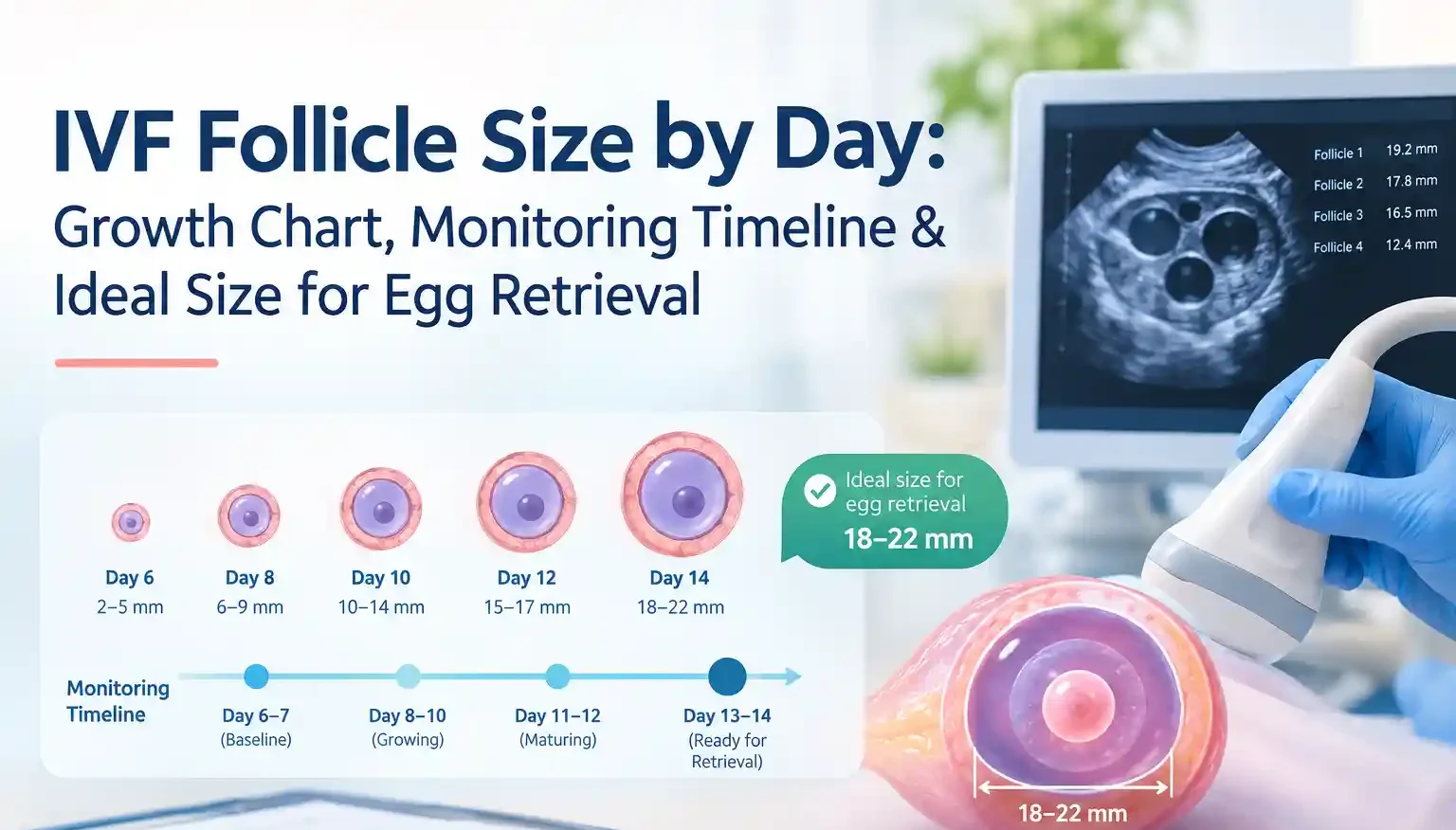
Starting your IVF journey feels intimidating. Every day, your fertility expert may mention medical terms that sound like jargon. Whether it’s estradiol levels, endometrial thickness, IVF follicle size by day, or the trigger shot, it can sometimes feel like you don’t know what’s going on. One of the most crucial aspects of IVF, and also the first step, is ovarian stimulation.
It determines the number of follicles prepared for egg retrieval. Now, follicles grow at different paces and are monitored through ultrasounds and blood tests regularly to determine your ovarian response to stimulation.
At Australian Concept, our fertility experts personalize IVF treatment, following stimulation protocols that work best for individual cases. Let’s understand the IVF follicle size by day, how follicles develop, and how to know if you are ready for a trigger shot.
What Are Ovarian Follicles?
Think of ovarian follicles as fluid-filled bubbles, containing developing eggs. They protect and support the egg as it grows and also produce estradiol. Not every follicle contains an egg, though. Once they have matured, the fluid is aspirated during retrieval and sent to the laboratory, where the egg is collected from each follicle.
Your ovaries have a specific number of follicles at the beginning of an IVF cycle. These are called antral follicles, which can be visualized on ultrasounds, giving your fertility doctor an idea of how many mature follicles can develop.
Hormonal injections administered during ovarian stimulation aim to grow multiple follicles, instead of one, thus increasing the chance of having multiple retrievable eggs.
As each follicle increases in diameter, the oocyte inside it also starts maturing. These follicles are visible on ultrasounds, providing real-time insights into their growth. Some follicles achieve an ideal size, becoming the leading, retrievable follicles.
Why Is Follicle Size Important During IVF?
Since you can’t directly measure eggs’ growth, follicular growth serves as an important clue that tells how well the egg inside it must be developing. With follicles growing at an expected rate, it’s assumed that the egg is likely to reach the mature stage, where it might offer a good chance at fertilization.
Now, many couples ask, “Does follicle size really matter”?
Yes. A study published by the National Center for Biotechnology Information grouped 640 follicles by size: large, medium, and small. They found that large follicles produced the highest number of mature eggs, followed by medium follicles.
However, when studying mature eggs only, they discovered that follicular size didn’t matter much. For example, mature eggs collected from small follicles had a similar fertilization rate to mature eggs from large follicles.
That’s why a fertility expert never waits for each follicle to reach 18 mm to administer a trigger shot. Instead, they look at different factors, such as estradiol levels, follicular growth pattern, your ovarian response to stimulation, your risk of Ovarian Hyperstimulation Syndrome, and the number of developing follicles.
IVF Follicle Size by Day (Growth Chart)
This IVF follicle growth chart clearly shows the average follicle growth rate on different days of IVF stimulation.
Before proceeding, remember that these are only approximate ranges. It may be absolutely okay if the follicles grow at different rates.
| Stimulation Day | Approximate Follicle Size | Meaning |
| Day 2-3 | 2–5 mm | At antral follicle assessment stage |
| Day 4 | 5–8 mm | Early response to stimulation |
| Day 5 | 8–10 mm | Follicles start developing |
| Day 6 | 9–12 mm | Multiple follicles can be measured |
| Day 7 | 10-14 mm | Difference between follicles is visible |
| Day 8 | 12–16 mm | Leading follicles can be seen |
| Day 9 | 14–18 mm | Many follicles might be near the ideal size that determines trigger decision |
| Day 10 | 16–20 mm | It must be time to start considering trigger shot |
| Day 11-12 | 18–22 mm | Leading follicles might be in mature-size range |
| Egg Retrieval | Trigger shot is administered to mature leading follicles. |
This IVF follicle size chart must not be treated as the definitive way to know when trigger shot and retrieval must be scheduled. The growth patterns can vary between women, and in many cases, small follicles measuring around 12-13 mm can also deliver mature oocytes.
How Fast Do IVF Follicles Grow?
Follicles grow 1-2 mm per day, but that’s an approximate range. The growth rate can greatly vary depending on factors like medication used, dosage, and follicular growth in early stages of IVF stimulation. These also help predict ideal maturation and retrieval date.
Let’s say IVF follicle size on day 5 measures 8 mm, so it should be 9-11 mm on day 6 if the above range is considered. However, it may not necessarily grow at the exact same rate. The pattern matters more than the numbers, which is why experts regularly monitor follicular growth to ensure they are developing at a normal pace.
Besides, follicular growth rate depends on many factors, such as maternal age, stimulation protocol followed, your sensitivity to FSH, baseline AFC, and AMH level. Based on your ovarian response, the fertility expert may adjust the medication dose in the middle of the stimulation cycle.
Mature Follicle Size Chart
Experts and even ultrasound scans or other follicle monitoring tools can’t correctly predict which follicle must have a mature egg. However, it’s true that the larger the follicle size, the higher the chances it contains a developed egg. This practical mature follicle size chart can help you decide the likelihood of retrieving a mature egg from specific sizes of follicles.
| Follicular Size | Chances of Mature Egg |
| Under 10 mm | Low |
| 10-12 mm | Low, but possible |
| 12-14 mm | Increased possibility |
| 14-16 mm | Good chance |
| 16-18 mm | High chance |
| 18-22 mm | Strong mature size range |
| >22–24 mm | Might still have a mature egg, but follicles larger than 24 mm might have overmatured eggs. |
What Is the Ideal Follicle Size Before the Trigger Shot?
Many clinics still follow the same standard 17-20 mm follicle size as an ideal range to consider trigger shot, but there’s no such thing as an ideal follicle size.
Each follicle might grow differently, which is why a fertility expert often looks at the bigger picture, i.e., the entire follicular group. Multiple follicles reaching a useful size range might drive the trigger decision rather than each follicle reaching the 20 mm mark.
Here’s what exactly the doctors consider:
- Leading Follicles: The follicles that have reached the maximum size in the cohort.
- Follicle Group: An IVF stimulation cycle where multiple follicles measure 18 mm is different from a cycle where one follicle has reached the 21-22 mm range, with the rest still within the 8-10 mm range.
- Estradiol: Estradiol levels might also provide useful information about follicular growth. Growing follicles produce estradiol; this shows a good response to stimulation.
- Premature Ovulation Risk: If the trigger shot is delayed, the risk of premature Ovulation increases. It’s when the egg is released before retrieval.
- OHSS Risk: If your ultrasounds show an abnormally large number of follicles growing, particularly in women with PCOS, a stimulation protocol may be adjusted to reduce OHSS risk.
How Many Follicles Are Needed for IVF?
There’s no strict criteria regarding the number of follicles needed for IVF. Many women with few follicles, around 3-5, have successful IVF cycles, while multiple follicles in another patient may never develop into healthy embryos. The goal is always to collect a large number of follicles, as it might provide more opportunities, but quantity doesn’t equal quality.
Age is another crucial factor that determines the number of follicles your ovaries may develop, but it’s not the only determining factor. Your fertility expert may consider AFC and AMH results to assess your ovarian reserve and decide a stimulation protocol based on the expected ovarian reserve.
Sometimes, women with as few as 2 developed follicles achieve pregnancy and give live birth. For successful fertilization, you only need a single healthy egg that has the potential to become an embryo.
Estradiol Levels During IVF
Another common sign of a growing follicle is increased Estradiol levels. It’s a type of estrogen hormone that prepares the uterine lining for implantation and early pregnancy.
At Australian Concept, tracking Estradiol levels is an essential part of follicle growth monitoring, as it provides useful information about follicular growth. However, there isn’t a fixed E2 level that indicates healthy follicle development. Your fertility expert will rather look at the hormonal pattern over the stimulation period to check if it’s rising steadily.
They may also check if the E2 levels and follicle size on ultrasounds are aligned and whether it’s rising rapidly or extremely slowly. These parameters help them decide whether the medication dose requires adjustment.
- High Estradiol: Too high Estradiol levels suggest a strong ovarian response. If it exists with an unusually large number of follicles, it might indicate an increased risk of OHSS.
- Lower Estradiol: E2 levels rising slowly or unsteadily may suggest fewer follicles growing than expected. However, it alone isn’t a reliable indicator of the number of developing follicles. Your fertility doctor will consider E2 alongside ultrasound findings.
Endometrial Thickness for IVF
While follicles are growing in the ovaries, they release estradiol, which helps thicken the uterine lining. For embryo transfer, the uterine lining needs to be thicker, approximately within the 7-10 mm range, for increased chances of implantation.
That said, there is no specific range of endometrial thickness that guarantees a successful pregnancy. Some studies have shown that a thin uterine lining, below the 7-8 mm range, has a comparatively lower chance of implantation than normal endometrial thickness.
Why Do Some Follicles Grow Faster Than Others?
It’s completely normal for follicles to grow at different rates. Some may appear larger by the time the trigger is administered, while others appear smaller. On ultrasounds, the follicles may appear like:
Follicle A: 17 mm
Follicle B: 13 mm
Follicle C: 19 mm
Follicle D: 10 mm
Follicle E: 18 mm
Just because a few follicles have remained small doesn’t mean stimulation has failed. Follicles react differently to the stimulation protocol.
There are also other factors that may affect their growth throughout the stimulation phase. Here’s a look at the factors that might contribute to the mix of mature and immature eggs:
- Medication Response: Not every follicle responds in the same way to the medication type and dose.
- Natural Variation: The growth pace can be slower for the follicles that may not be of an optimal size range at the beginning of the IVF cycle.
- Age: Your ovarian response depends largely on the maternal age. Since ovarian reserve diminishes in the late 30s and 40s, there may be fewer follicles and, that too, in the small size range.
- PCOS: Women with PCOS might have ovaries that respond strongly to the ovarian stimulation, which is why close monitoring is essential during the stimulation phase.
Can Small Follicles Catch Up?
Yes, many small follicles that measure 10 mm might grow rapidly, becoming 15 mm large follicles over the next few days of stimulation. However, whether the fertility doctor can allow more time for the follicle to develop depends on the risk of premature ovulation, estradiol levels, its growth pattern so far, and the size of other leading follicles.
For example, if a follicle measuring 13 mm has a normal growth pattern, the fertility expert may extend the trigger for 1-2 days, but only after assessing the risk of premature ovulation. It’s important to note that not every small follicle is automatically useless.
Many such follicles contain a mature egg, which has almost the same fertilization and embryo development potential as eggs yielded by large follicles.
What Happens If Follicles Grow Too Quickly?
Sometimes, follicles develop too rapidly, increasing the risk of spontaneous ovulation. Your fertility team will carefully track the follicle growth and adjust stimulation medicines to prevent premature ovulation while allowing follicles to reach an optimal size for retrieval.
That’s why GnRH antagonists are commonly used during stimulation to prevent the LH (Luteinizing Hormone) surge (a hormone responsible for triggering ovulation).
The risk is particularly higher when some follicles remain smaller while the leading ones have reached the maximum size range needed for retrieval. If the fertility team waits too long, these already-matured follicles might become overmatured.
What Happens After the Trigger Shot?
Once the follicles seem to have achieved an optimal size, the fertility specialist might administer a trigger shot, which is carefully timed to ensure the eggs inside the leading follicles achieve the final step of maturation.
Remember, the trigger injection doesn’t enlarge small follicles. It rather triggers hormonal events that mature the eggs. It’s timed 34-36 hours before egg retrieval. This carefully planned duration ensures that your egg matures well and is retrieved before ovulation occurs.
Retrieval is a minimally invasive surgical procedure, performed under anesthesia. Your fertility doctor uses a thin catheter with a suction to aspirate follicular fluid. The fluid is examined in the laboratory to identify and retrieve oocytes.
FAQs
What follicle size gives the best IVF success?
There’s no fixed follicle size that’s considered ideal for IVF success, but most experts believe the 16-22 mm range can provide mature eggs.
Is 17 mm mature enough?
Yes, but follicle size alone doesn’t tell if it can contribute to a mature oocyte yield.
Can 15 mm follicles contain mature eggs?
Yes; however, the possibility is comparatively lower than in larger follicles.
How many follicles are considered good?
A follicle count between 10 and 15 is considered good, but it can vary depending on your age, ovarian response, and stimulation protocol.
What size should follicles be on Day 8?
Depending on the stimulation protocol, the follicles may reach 12-16 mm on Day 8.
How many eggs are usually retrieved?
An average IVF cycle yields 8-15 eggs, with 10-15 considered a good mature egg count, but the exact count can vary greatly based on how your ovaries respond to the stimulation cycle.
Do all follicles contain eggs?
No, not all follicles contain eggs.
Can follicles shrink?
It’s less common, but possible. Follicles can shrink or disappear during stimulation.
Why are my follicles uneven?
That’s pretty common. Each follicle grows at a different rate and starts at a different developmental stage. Their response to ovarian induction drugs may also vary.
Can IVF work with only two follicles?
Yes, implantation and pregnancy are possible with two follicles, given that they yield mature eggs, which develop into embryos.
Does AMH affect follicle growth?
No, AMH isn’t relevant to follicular growth. It’s used as a marker for ovarian reserve, but it can’t directly tell follicle growth status.
How often are ultrasound scans performed?
It depends on the clinic’s monitoring protocols. Typically, the first scan is conducted before stimulation, followed by another scan as the stimulation progresses. Multiple scans may be needed when the follicle reaches the trigger stage.
Conclusion
This IVF follicle size by day guide shows how follicles develop at different paces and their size range on specific days. However, this is just an approximate range, not the strict criteria. Follicle size monitoring isn’t just about measuring the numbers, such as 16 mm or 22 mm.
Your fertility doctor is looking at the whole picture, which covers estradiol level, endometrial thickness, and your ovarian response to plan the appropriate time for the trigger shot and retrieval. If you still have questions about follicular growth and its effect on your fertility outcome, feel free to reach out to a fertility consultant at Australian Concept.





2 Comments
Muhammed Ahmed
Assalam o Allikum
MA SHA ALLAH we have 4 kids, 3 Daughter and 1 Son.
Physically both are fit.
we wish a baby boy for completing our family.
I am not a rich man. I am simple account assistant in a real estate farm and dose not afforded so much fees recently i have receive a comety PKRs 80,000/-
If these rupees the process are possible then Please contact me
We both are at the age of 40
Regards
Muhammed Ahmed
ACIMC Webmaster
Dear,
We have experienced Consultants at ACIMC. Please come for a first free consultation with coordinator doctors.
For an appointment please call on our UAN: 0304-111-2229, WhatsApp: 0309-333-2229